Sunday, December 6, 2020

Game 48 - Tenchi Muyo! Game-hen


Tenchi Muyo is an old school anime (at least in the English world); I remember it being one of the small number of things available in English when I first started watching anime, although I never actually saw it. It's a basic "harem" anime where this normal high school student gets surrounded by a bunch of women. In this case most of them are aliens, Galaxy Police, or other such characters. The first OVA series came out in 1992 and by the time this game was released, there were a total of 2 OVA series and a 26 episode anime. The series is actually still going on, with a new OVA series this year.

The game doesn't make any attempt to set the background up for the series or introduce the characters (although probably there was some explanation in the instruction manual). That being said I didn't find it difficult to follow at all. The character types are pretty broadly conceived and easy to understand, and the plot itself doesn't seem to rely much on previous knowledge of the series.

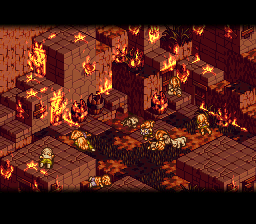
Definitely the best part of the game is the graphics and presentation. All of the figures are large and detailed, with unique animations for each attack, animations for getting hit, and various animations and picture graphics during the story sequence. Each character also has voicing during their moves; it's very limited but adds to the appeal.


The game, however, is lacking in a lot of areas. It is quite short and easy, and can be finished in just a couple of days.  This is fine for 2020 when most people playing it probably aren't paying for it (or if you are, it's $7 on ebay or $25 with box and manual). But I can imagine that being frustrating for the original audience who paid 10,000 yen. I would rather play a short, easy game that has design flaws than a long frustrating one.

Each character has 8 levels. The level ups are based entirely on number of monsters defeated, but there's no way to check what the current number is. But this is kind of strange that beating the  earliest monsters in the game provides the same "experience" as the final monsters. 

Each level grants a new move for the character. This is nice, and I appreciate when characters grow throughout the game and learn new powers. The powers use the "kiai" stat, which you see as the green diamonds to the right of the picture above. You recover some kiai each turn and the stronger moves use it. If you have full kiai, most characters can Morph into another form, which grants different powers, and the Morph lasts until the kiai reaches 0. This aspect of the gameplay is good.

However, there is no equipment at all, and only 4 characters per battle. The characters movement is very slow, and seems to be a Tactics Ogre system where turns are based on speed and if you don't move or act, your turn comes up more quickly.


There are 12 total characters. Some are optional or (slightly) hidden. The differences between the characters are pretty stark, with some characters being nearly useless. The party I have above (Sasami, Katsuhito, Washu, and Shitsuki) are pretty clearly the best party, although Tenchi could be subbed in for Katsuhito without too much trouble.


There is a world map (three of them) and you can choose where you go next, and you can go back and forth between places to level up. Typical battles are against 4-6 enemies with some reinforcements slowly coming in as you play.

The basic story involves this woman Shizuki coming in and capturing Sasami, and then we have to go rescue her. But then it leads into another fight against the purple haired person above, and you go to the moon to defeat her. The plot is decent enough but nothing all that special.


At the end you get a "maniac grade"; I only got 60/100 because I only moved 4 characters up to max level. If I had done that with the other 8 I would have gotten 100%.

This game is nothing exceptional, but it's fine for a casual play. It can be finished in less than 8 hours. If you're a fan of Tenchi Muyo! it's definitely worth a try, but even if you aren't, it's a perfectly playable game.
 

Friday, November 27, 2020

Game 47 - Tactics Ogre (wrapup)


  1. Turn type: Turns based on WT (see first post)
  2. Maps: Medium
  3. Character Customization: Characters can change class freely (if they meet the stat requirements)
  4. Character Development: Standard XP/level system.
  5. Party Size: 10 in one battle.
  6. Equipment: Four equipment slots (including items)
  7. Game Flow: Sequential battles, with random battles and training available. Chapters 2 and 3 have multiple routes.
  8. Saving: On the world map
  9. Death: Permanent


As I said in the first post, this game is innovative in many ways. The storyline is strong -- in its complexity and depth it's far beyond any other SRPG that has come before it. I don't know if this game in particular inspired other designers, but going forward there are a number of other games that incorporate the kind of complicated political situations and warring empires that we see in TO.

This also is the first game to really incorporate 3D maps, with height playing a significant role in the game. The game also offers a lot of replayability, with two Chapter 2s and three Chapter 3s. You can also recruit a wide variety of monsters and special characters, meaning you can play the game through with totally different parties.

That being said, I think there are some significant flaws in the game. The first one is how unbalanced the different classes are, and the flawed implementation of the armor system. The second is that being just a few levels below the enemy makes it very hard to fight them -- they can often do enormous damage to you and do very little in return. This means you have to spend a lot of time in training equalizing levels, and if you fall too far behind the story bosses you may even have to grind up.

As I've mentioned in the Fire Emblem posts, I also do not like permanent death. I think maybe it's not as bad in this game as others because you can persuade enemies to your team, but it's annoying when enemies gang up on someone and kill them in just a few hits.

Ultimately I think this game is worth playing, although I would recommend either the Playstation version or just use save states on the Super Famicom version to simulate how things would be in the PSX version (where you can save in the middle of a map).

The designers would go on to implement many of the same kind of ideas in Final Fantasy Tactics, which has some of the flaws and good points of this game.

Sunday, November 22, 2020

Game 47 - Tactics Ogre (Part 2)

I have now finished TO so I will try to cover the rest of the game in this post.

I took the Law route, which means I will be doing chapter 2L and 3L. The Neutral chapter 3 is only available from the Chaos route, and then the routes converge in chapter 4. The Law route involves sticking with the Walstan side despite their slaughter of the innocent people in Baramus.

The old LUCT site has a translation of the entire story if you want to see it in detail.

The first few battles of this chapter aren't bad as we head towards Ashton, but the Ashton battle is rough. This is the only time in the game I had to grind levels beyond just equalizing everyone's level. The enemy leader, Aloser, is an archer and is quite strong. She could kill a number of my guys from full HP with 100% chance from the front, and even if she couldn't, the other enemies could pick them off. I found that in general, being more than 2 levels below the enemy leader made it quite difficult.

Kurisu is a berserker there, which was a mistake -- I forgot that his alignment would not qualify him for Terror Knight. By chapter 4 I had changed him to a Ninja and then a Swordmaster. He was never one of the stars of the team, but with a spear he managed to do OK. He also was my main caster of Petrobreath. It took me a long time to realize how good this spell is, but if you can cast it over an area you can take multiple enemies out of the battle completely with one spell. This helps also with collecting the stat cards and healing in multi-part battles.

The next tricky battle is against Wynoa; she has a fire orb and uses it first round to do big damage to a lot of people. So it's time for the Cure Leafs.

After Duke Ronway's feint attempt fails, Leonard decides to have Kurisu assassinate Ronway and assume command of the Walstans. He agrees, and we head off to Amorika, but face Vice and Aloser again on the way. This is another tough fight because they both have bows and can team up on guys.

Then it's on to Amorika, where we fight a big battle inside.

The main challenge of pretty much the rest of the game is just preventing guys from getting ganged up on and killed. I had to try a bunch of different approaches to this until I was finally able to take out the knight.

Then we have a one-on-one with Leonard; his actual plan was to have Kurisu kill Ronway, then he would kill Kurisu to unify the Walstans after killing Ronway's assassin. It's Vice and Kurisu vs. Leonard.


Vice does most of the damage here, but I think I gave Kurisu a bow also so that he could keep out of Leonard's way. With Leonard dead, Kurisu gains control of the Walstan army. The next battle is annoying.

The terrain and weather really benefit the enemies a lot, particularly the dragons. It's a slog to beat them all. I then picked up Jenounes at the next castle, who turned out to be an excellent person all the way to the end. He got a Firedrake sword which made him very effective against dragons.

The rest of the chapter was fairly smooth, especially once I got Vice and the other new units who were quite good. This was essentially my party for the rest of the game, except that I replaced the cleric with Kachua once I got her:


I had some trouble with this fight near the end of chapter 3:


The enemies don't move until you cross the river at the base, and as usual they can team up on someone and kill them pretty easily. So you have to play it cautiously (and if you realize how broken Petrobreath is it's probably easier than it was for me).

The most bullshit fight in this chapter, and possibly the game, is the 1-on-1 vs Oz near the end of 3L. I don't like it when games spring this kind of battle on you, particularly as the second battle in a sequence where you can't save. Oz can kill Kurisu in two hits which makes it very hard to survive here -- in the end I had to do a lot of class changes and different combinations until I beat him (I don't remember the exact setup).

Chapter 4! Kachua is now a queen and we just have the Lodis people and Branta left. From here to the end, the majority of battles were overall the same -- the basic tactics involved just waiting for the enemies to come, going mostly for the leader, and equalizing levels between battles. By the end of the game I had developed by team enough that I could do more than just beat the leader.

The Barbas fight was tough until I could get him to move into the right spot where I could gang up on him. The next fight against Lancelot was quite difficult. I honestly can't see playing this on a real console where you can't save at all during or between battles. Lancelot did an enormous amount of damage to my guys and it was just a chess game to make sure that he and the Warp Knights could not kill anyone.


Branta at the end is not too bad because he's a Bishop, so his defense is quite low. As long as you can avoid the Terror Knights killing anyone, just getting a few units into his range should finish him off (although those Angel Knights he summons are annoying).

The last section is Sky Garden, which is a sequence of as many as 18(!!!) battles without any saving, followed by a sequence of 4 battles without saving. Before this I went to Hell Gate just to get Fudo on level 6.


I ran into trouble when the Dragon with a Wind Orb showed up. I had to do a lot of maneuvering before I could survive that battle; in the end I had to take a death of my Wizard, but he had the Death Ring so he became a Lich. I gave Fudo to Jenounes since he had high DEX and good defense.


The final battle is rough. Dolgare has ridiculous defense and comes with a lot of scary dudes. Fudo is really the key here since it ignores defense -- two hits from Jenounes was enough to kill him along with one bowshot. Canopus died in the final battle, which was sad since he had been one of my most important characters for the whole game.

Overall I have mixed feelings about this game but I will sum them up in another post.

Sunday, November 1, 2020

Game 47 - Tactics Ogre (Part 1)

Tactics Ogre: Let Us Cling Together (タクティクスオウガ) 
Released 10/6/1995, Developed and published by Quest
 
"Turbo File" was a Japan-only accessory for the SFC that allowed you to store save games externally
 
This is the second game in the Ogre Battle franchise, representing Chapter 7 in a theoretical eight chapter story (although the plot has basically no connection to the original game which was Chapter 5). Like the first game and the franchise name as a whole, the title is taken from a Queen song. The game is very different from its predecessor -- while it kept the general character classes and the "Chaos Frame" (reputation) idea, the game is a 3/4 view strategy RPG rather than a real time strategy game. Both the story and gameplay are clearly heavy influences on the later Final Fantasy Tactics.

The plot is a huge advance in storytelling for SRPGs; I can see this clearly from having played pretty much everything that came before. Probably the most developed plots before this were Der Langrisser and Super Robot Taisen 4, but neither game really comes close to the complexity of TO's storyline and characterization. Apparently the designer Matsuno was inspired by the breakup of Yugoslavia and the resulting ethnic conflicts and atrocities. I'm old enough to remember the NATO bombings during Bill Clinton's presidency. In the TO story, the land of Valeria was united under King Dorgalua, but he died with no clear heir and the kingdom broke up into the former ethnic groups -- the Bakram, Galgastan, and Walstan. The main character (Kurisu, the default name is Denim) is Walstan, and at the beginning of the game the Walstani are the weakest of the groups, having been the subject of ethnic cleansing by the Galgastan theocracy, and having these two powerful states around them. Kurisu, his sister, and his friend Vise are members of a resistance force trying to free the Walstani.

Having the main character be in a resistance army is not a new thing; I've played several games before that have this. What sets this story apart is the moral ambiguity of all the sides; drawing from real conflicts, Matsuno avoided the usual trope of making the resistance army the band of heroes of the light vs. the dark, evil empires. I'll put the more spoilery stuff lower in the post if you want to avoid it.

Incidentally, this is the first game I played in Japanese where I actually tried to look everything up and understand it. I played it in 2002 or 2003, although I think I stopped playing in the middle of chapter 2. 

You start with an opening section that's like Der Langrisser and some other games, where you answer questions to determine the starting stats of your main character. Unfortunately the questions are incomprehensible and give you no indication whatsoever of what kind of character you're creating or what's going on. 


The game begins with a few missions that are basically tutorials, where you have a battle mostly with guests and we free Duke Ronway of Walstani. We then become his "young heroes" who will fight to ave the Walstani people. I'm not going to go into great detail on the plot since you can play this in English.


The game is graphically impressive, and apparently the game was delayed as much of a year largely because of how much effort they put into the graphics and especially the sprite animations. Matsuno eschewed the typical anime style of characters and went with a more realistic look.


Of course the victory screen is where the title of my blog comes from -- as I said the intro, the phrase perfectly captures what to me is the essence of a SRPG, when you struggle and think your way through a stage to finally beat it and get the Congratulations message.


After that first set of battles, we're on our own. Kachua (Kurisu's sister) and Vice are NPCs who you can't control, and then you have a set of soldiers and valkyries. Just like in Ogre Battle, they need to be levelled up before they can switch to other classes.

The battle system is based on WT -- rather than a turn-based system, characters act based on their WT, which is lowered by agility and not having too much equipped. Other games before this have had speed-based turn systems, but this may be the first game where characters act entirely based on their WT and there is no concept of a "turn" where everyone acts. Characters who choose not to move or not to act will act more quickly, and it is possible for one character to take more actions than another. I can't say for certain that this has not been done before because some games were a little ambiguous, but it could be.

The problem with the system is that they didn't quite get the balance right. Equipping armor lowers your WT. Everyone can equip any armor, but certain classes benefit more from it because the defense increase is related to a P. RES stat that is based on your class. The problem is that the way they implemented the system means that armor is rarely a good choice for anyone, because the speed, hit, and dodge penalties you get are not worth the defense increase from the armor.


The game also has height and facing -- Front Mission had height and I think maybe Lady Phantom had facing, but neither system was common at the time this game came out. The other unusual system is that everyone starts a battle with 0 MP and the magic points recover as the time passes. This means that you cannot run healers out of MP or anything like that. Magics are equipped, and the AoE of the magic increases based on your caster's MEN stat.

Each character also has an element, which affects their stats based on the type of ground they stand on, and also their compatibility with enemies.

Denim can recruit enemies by Persuading them; this is more useful for getting their equipment than actually recruiting them for your team, although it's the best way to get monsters on your team. The problem is that characters have a Loyalty stat that's pretty low for enemy persuades, and they might leave your team if things get too bad.

The game has permanent death of units. I have said in my Fire Emblem reviews that I do not like this system. Especially in this game where differences in levels make such a huge difference, it often becomes necessary to train between battles just to keep your levels equal, and sometimes you even have to level up more. The grunts in a mission are all set at the highest level guy you have, but the leaders have fixed levels. There are several battles that pit you against archers that can do enormous damage with 100% chance to hit even from the front, making it hard to survive the battle without doing some outside levelling.

The PSX version allowed in battle saves so I have been using some save states, but even so you can't just keep reloading until they miss (that would be tedious anyway).

This is my party near the end of chapter 1. The Chapter 1 ending has a big choice -- Duke Rowen's plan is to massacre a town of Walstan to try to raise support for fighting against enemies. Denim gets to choose whether to participate in the massacre or go against Rowen. Regardless of which you pick, Denim does not actually do the massacre himself, Vice becomes your enemy, and Denim gets a bad reputation. I went for the massacre route because the "don't do it" seems like the obvious choice that a lot of people will take. This puts me on the Law route.


Those are some pretty intense scenes for something that your main character approves of!

I'm currently near the end of chapter 2. My party is basically the same as above. Kurisu is a barbarian, but bows are still much better than anything else. The Archers are the overpowered class of this game (I'm using two). I just lost a fight and will need to equalize everyone's levels and try again. But I don't want to get in a cycle of "rush the leader and win the battle, train to equalize levels, repeat" because that's just not a satisfying way to play a SRPG. But leaving the leaders alive often mean opening yourself up to a unit dying with little notice.

Sunday, October 18, 2020

Game 46 - Heian Fuunden


Heian Fuunden (平安風雲伝)
Released 9/29/1995, developed by KSS


  1. Turn type: Speed based turns, although I believe everyone gets one turn before another person gets two.
  2. Maps: Medium
  3. Character Customization: None
  4. Character Development: Standard XP/level system.
  5. Party Size: 8, although you have multiple groups each with 8 people.
  6. Equipment: One weapon, one armor.
  7. Game Flow: See below
  8. Saving: Before each battle
  9. Death: Permanent

The Heian period is not a common setting for manga or video games -- in general things were much more focused on the genteel life of the court rather than adventures or battles. But there are stories and legends that can be drawn on. This game is set in 1000, around the time of the Tale of Genji and other courtly romance fiction, and while the story uses some of the court figures, it's more about what was going on outside of the capital (you can't enter the palace at any point).


The back story is that Emperor Kazan in 984 had twins with Fujiwara no Shishi, who died in childbirth. One of the twins died, and the other was banished to Kumano to become our main character (in actual history, Shishi died in her 8th month of pregnancy). 16 years later, the Yamawaro rebel against the Heian goverment -- this game depicts the Yamawaro as an ethnic minority (later portrayed as demons in legends). Fujiwara no Michinaga, who was the real power in the capital at this time, calls on the Onmyoji Abe no Seimei to help protect the capital, and his disciple Douma attempts to revive the soul of Taira no Masakado, who rebelled against the capital 60 years ago.


All of these people are historical figures (except the main character, Kagura). There are other historical figures in the game -- the warrior Minamoto no Raiko and the poet Semimaru, for instance. Although most of the enemies and people you get on your team are fictional. It is impressive how many historical figures they were able to include, though.

The development of the story itself is not that surprising; Kagura ends up having to fight both the Yamawaro and Douma and his followers trying to revive Masakado. There are a few twists here and there but overall the story is not exceptionally detailed.


The game basically divides into two parts. The first half you're dealing with the lands to the west of Kyoto, the second half they're on the right. The game has a map system where you see all the enemies on the map -- the fixed encounters are squares, and from some of those locations, additional enemies will come out (as circles) and start marching towards the capital. If any enemy reaches the capital, you lose. I was initially worried about this mechanic because it seems like you could save yourself into a position where you would have to start over, but it's not a big deal. The game does give you multiple teams, but even this was hardly necessary. The enemies move so slowly that except for one battle I never used anyone but my main team. It may also be the case that if you defeat the square enemy than the circles were coming from, the circles that are already out freeze in place (I'm not sure of this).


So basically the game involves visiting all the square enemies and defeating them; eventually new square enemies will pop up, until you finish the game. There are two parts (near the end of the game) where you have to go to certain places to fight battles that don't have a square; they're indicated by the dialogue so it's not very hard to figure out. There are also random encounters with bandits if you're not on a road.

Once you get into a battle, it's typically your party vs 8 enemies (there may have been some early battles that didn't have the full 8); your party can go up to 8 people. The turn order is determined by speed, and you can see the order by exiting from the current unit's turn. The battle system is fairly standard, with units able to move, attack, use items, or special abilities. There are a few additions that I didn't make much use of -- you can summon a shikigami which I consistently forgot about, and some things having to do with units next to each other supporting or doing stat increases (I didn't know about this until I beat the game). 

Your units have a number of different classes. Some of them are restricted to a small number of units -- the Shikigami User is only your main character, and the Ise Priestess is only Uzuki.Other classes like Warrior and Omyoji have more. Within the classes different people will have different arrangements of abilities. One disappointment is that nobody ever learns new skills, other than the main character being able to summon more types of shikigami. It may seem odd that I never used this ability but Kagura is so powerful that even though I completely forgot about this she was very useful. Levelling up raises their stats, and gives them more uses of each technique.


My main party was as follows:

  • Kagura, main character. She has an attack all spell that's very powerful, as well as line attack and single attack spells, and her regular attack is good too.
  • Semimaru, Biwa player. She has an attack all spell that also makes the enemies unable to use spells, which is useful for dealing with the many healers.
  • Touta, a "spirit user". He has early spells that can attack in all directions, and a line attack.
  • Raiko and two other warriors I forget the names of -- front line attackers.
  • Jinku the monk, another front line fighter.
  • Suzume the shrine maiden, a starting character who has an infinity range heal and a "heal all" spell, plus attack spells
  • Uzuki the Ise Shrine maiden, who replaced one fighter once I got her. She has a heal + buff all spell, plus attack spells.

The balance on the whole seems off. Some characters have incredibly powerful attacks and others can't do much. There are a large number of characters though, including many optional ones. I also found the balance of the individual battles was off as well. The enemies often have heal-all and attack-all spells, plus they summon these shikigami that are ridiculously powerful in the early game. So I often found myself having to do rushes with Kagura and Semimaru's attack all spells just to get the healers and leader down before they would overwhelm me -- the permanent death system makes this even more necessary. All battles end when the leader is destroyed. The game is not especially difficult as a whole, but I did often feel very constrained in my strategy choices by this lack of balance.


When you hit someone, it moves them a square, usually back but sometimes in one direction or the other. There's also some kind of zone of control system where you can't pass by enemies. So there is more to the fighting than just moving forward and attacking; you often have to take advantage of pushing enemies aside to reach the boss.

Between battles HP fully recovers, and you can rest in houses to recover technique and spell uses. This doesn't take any time (as far as the enemies moving on the map) so you can do it pretty freely, with the exception of the final three battle sequence which have to be done in one go. 

There is no money in the game. Instead you get items and equipment from fights -- the equipment is not a major part of the game. You can trade it with merchants for healing items, but I hardly used these either. 


Overall this is a decent game. The battles are quick and even if you lose you can just try again immediately since you save before each battle. The story involves a lot of historical stuff and mythology, although it could have been a little deeper. One tip -- to get the "true ending" you have to have Semimaru and Uzuki (the Ise Priestess) in the final battle and they both have to survive. I believe that you automatically get Semimaru. Uzuki is optional but not very difficult to find.

Sunday, October 4, 2020

Game 45 - Bounty Sword (end)

I finally finished the game; this took a long time. I found a similar pattern to other games I've played -- things that were initially minor irritations became major problems with the game. While overall I think this is a decent game for the time, there are three big issues with it.

The first is the pathfinding. I felt like I was constantly fighting with the AI to get the units to move to sensible places. Especially any map with a river bridge or narrow steps was a nightmare because the characters would often have a tough time finding it. Even if they did, if there's anyone on the bridge blocking their way, they immediately turn around and try to find a different way across. 


The second is the AI options available. They really need a "stay away from the enemies" option. Way too often the healers and magicians move right next to the enemies for no good reason. A "stay together" option would have been nice too.

The third problem is one that I also encountered in Hiouden, the only other RTS game I've played so far. Some of the later enemies can only be beaten by spamming moves, and it's hard to open the menu when you have spells and moves going off all over the board, each of which pauses the game and takes you to that unit. A lot of the later battles involve using moves and then hammering A to get the status screen up again so you can use the move again before the enemy heals itself or uses some nasty move.


Coming into the third section of the game I was stopped for a while against one of the Machine Gods (one of 12). I did barely any damage to it and it healed itself. Eventually I watched a youtube video and follow their strategy -- I leveled up Mika the Ninja until she became a Ninja Master and could use Bunshin-giri, which is a powerful technique that I used on many bosses after this.


The story basically disappeared in the third section. Kurisu becomes the leader of the resistance group against the Empire for no clear reason, and every map is just clearing out more Empire forces. Eventually there's a bit more but it doesn't rise above RPG cliches, which was unfortunate given the promising beginning.

I wrote some about the "12 rings" you could find in the game -- I was under the impression these were optional items, but they are required to finish the game. Most of them are not hard to find; you just revisit areas after you finish them and they'll be there.


My final team was Faust the magician (pretty overpowered), Mika the Ninja Master, Kurisu, Roger the Dragon Knight, and Milandra the Bishop. Usually the battles involve keeping the team together, although trying to get the mage and priest away from the enemies. Kurisu, Roger, and Faust have good crowd control moves while Mika is useful for taking out bosses.

There was one stage I could not beat -- it had a wizard who cannot be hurt, but uses these incredibly powerful spells. I guess you have to beat everyone else to win the stage, but it's not a required stage so I just skipped it.

I think this game could have been a lot better. Unfortunately Double Edge is not well regarded, so it may not be much better than this.

I think this means 3 hours and 25 minutes total for the battles, although that doesn't count the pausing.