Sunday, May 17, 2020

Game 34 - Front Mission

FACTS

  1. Turn type: Player/enemy turns.
  2. Maps: Medium. Terrain gives bonuses, and there is height.
  3. Character Customization: Mechs can be customized (see below)
  4. Character Development: When you move up an XP level, XP gets assigned to four areas of fighting, and can lead to learning new skills.
  5. Party Size:Usually in the 8-11 range, although up to 17.
  6. Equipment:  Mechs can hold two weapons, and have two shoulder weapons in addition.
  7. Game Flow: 29 stages, no alternate paths or repeated stages. Towns have colosseums you can train in.
  8. Saving:  Before battle. There are in-battle saves; the manual says they get deleted on load but in some places you have to play 2-3 battles in a row so I have a feeling there must be some way to do a permanent save that I wasn't aware of.
  9. Death: Pay a cost after the battle to repair defeated mechs. If the main character dies, game over.


IMPRESSIONS 

Once again I failed to do stage-by-stage updates, but since this game is easily available with a translation patch everyone can try it themselves. My main impression from this game is that I was expecting a lot out of it -- a Square game with big names involved in the development, and I felt like I had heard it hyped up. But I found it rather disappointing. It's not a bad game, but it has a lot of flaws.


The story is fine for 1995. Here's the opening story from Wikipedia:

Set in 2090, the story of Front Mission takes place on Huffman Island, a fictional Pacific Ocean island roughly the size of Oahu, created by volcanic activity south of Mexico's west coast in 1995. In 2002, the land mass was classified as an island, and was ceded to United Nations control. However, in 2020, the United States of the New Continent (USN), a unification of North American and South American countries, made a bid for control of the island after withdrawing from the United Nations. The Oceania Cooperative Union (OCU), an alliance of the nations of South Asia, South East Asia and Australia that was created in 2025, dispute this claim when the two superpowers colonized the island in 2065. The tensions heat up and eventually lead to the 1st Huffman Conflict in 2070, with Huffman Island being divided into two halves at the end of the war. An uneasy peace is maintained until the Huffman Crisis in 2086, when a series of skirmishes across the island causes chaos. Tensions flare up and end in war when the OCU is blamed for inciting the Larcus Incident on June 3, 2090.


The main character can be named; his default name is "Roid" (Lloyd?) but I went with Kurisu. The game opens with the final sentence in the above description -- Kurisu goes to investigate a munitions plant along with his fiancee Karen. A USN dude named Driscoll kills Karen and blows up the plant, setting off the war. Kurisu is blamed for the war, chased out of the military, and turns to fighting in coliseums for money. But he's recruited into a special mercenary force in the OCU. The first part of the story involves the war against USN, but this evolves into a more complex plot later.


There are a number of people you get on your team. Most of them are just there, with a bit of backstory, but a few of them have deeper involvement in the plot. Of the antagonists, only Driscoll really gets that much development.


I believe this is the first SRPG to have height, although it was not always clear to me what difference it makes. I think it affects the range of long attacks, and you can't use fight/short attacks if there's too great a height difference.


Each mech has four areas of damage -- the body, right and left arm, and legs. When you make an attack you harm one or more of those areas randomly (I think). Destroying arms removes that weapon, destroying legs lowers the movement, and destroying the body kills the mech. Although this sounds interesting, in practice I found that when attacking enemies it didn't make much of a strategic difference. Once you get the Duel ability (which lets you target a part), it seemed like it was pretty much always a good idea to target the body. Maybe I could have done better taking out some of the weapons first if I couldn't kill the mech in one turn, but the game was never challenging enough for that to matter.
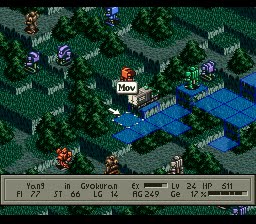


If a unit gets destroyed other than the main character you pay a small repair fee and its back the next turn. I never felt like I had to protect anyone other than the main character, since that's game over if he's destroyed.


There is a lot of customization you can do with your mechs -- 4 body parts and 4 equippable weapon areas. Unfortunately the game doesn't really give you a good reason to think about the process much. You basically just buy the strongest stuff for everyone. Some people excel more at Short, Long, or Fight, but that only produces minor variation in the overall setup. It becomes tedious to upgrade everyone's mechs at a new town.


The Short, Long, Fight distinction helps each character learn skills. I wish they would give you a better idea of when you might learn skills; it seems like just a random chance when you move up a level. There's also a huge difference in difficulty with these skills. I found the game quite challenging in the early stages, and it's even more challenging if you don't have a good idea of how to set everyone up. But once you start getting characters who can do a double attack targeting the mech body, you can kill most things in one attack and the game becomes significantly easier. Even the bosses can barely stand up to a few characters with good skills. The final boss can be defeated by ranged attacks outside of his own range, which is a surprising development oversight.


There also is not enough variation in the enemies you fight. They have some different weapons, but they all basically look like the same mech. This paired with the balance problems I mentioned earlier meant that I was hardly ever looking at enemies and saying "Oh, I'll need to use this particular strategy to fight those guys."

The graphics are a high point for the game. Yoshitaka Amano's art is used more or less directly in the game, and gives the game a certain atmosphere that is different from the usual "anime kids against the world" motif. The mechs look decent in the battle sequences, and the attacks are fast-paced and you can see what's happening.


This all seems pretty critical, and I guess it is, but the game is OK. I'll be interested to see if Front Mission II takes the good ideas FM1 has and improves on them.

Friday, May 1, 2020

Game 33 - Farland Story

Farland Story (ファーランドストーリー)
Release Date: 2/24/1995
System: Super Famicom
Developer: TGL
Publisher: Banpresto


The Farland series of SRPGs started on computers in 1993, and between 1993 and 1996 there were eight games in the series. A number of console games came out as well, some of them ports of the computer versions, and some new games. According to the back of the box, this game is a combination of the first two computer games, although it's only 24 stages so I don't know if the computer games are just really short or whether this is really a remix or new creation based on those games.


Unfortunately, this game is about the blandest, lowest effort creation you can think of. The system is less developed than Fire Emblem 1 for the NES. Each character can move, and attack or heal. That's it. There are no skills or spells -- healing is implemented as attacking your ally (it even uses the same command), and nobody has MP. Magic doesn't work on actual spells, it's just the attack of the magician. There are no class changes, no new powers, no anything. On stage 1 your main character can make a range 1 attack. On the final stage your main character can make a range 1 attack.


This is incredibly lazy and disappointing for 1995, a year that is going to see SRPGs like Front Mission, Tactics Ogre, Der Langrisser, and Super Robot Taisen 4. They were churning them out, though, because Farland Story II comes out in December 1995 with a Saturn remake later.


I played three stages of this game and that's enough. The game begins with Ferio being captured by a black knight, and a small group of people led by Ark has to go in chase of her.


The graphics are pretty pathetic. I guess the only thing the game does that isn't standard is that it uses a hex map instead of a square grid. The game plays very slowly; the maps are larger than they need to be and the enemies often don't move until you get close to them.


There are little places that look like flowers or gems; if you approach them they reveal treasure chests and you can open them. There are also towns and forts; the town system is strange. You can buy things, but only if you do it at the beginning of your turn, before you move. Then you'll also have a conversation with a townsperson to get information, but that only happens if you pick "shop".


The bosses are usually surrounded by units who don't move, but you have to approach them carefully and sometimes just use one character to take them down from range 2 distance or they'll overwhelm you. Especially the axe users have very low magic defense.

Anyway, there is little reason to play this game, unless you are so starved for Super Nintendo-era SRPGs that you'll play anything.

Wednesday, April 22, 2020

Game 32 - Majin Tensei II: Spiral Nemesis wrap-up

FACTS

  1. Turn type: Player/enemy turns.
  2. Maps: Medium. Terrain gives bonuses.
  3. Character Customization: On level up, you can assign a point to any stat.
  4. Character Development: Standard XP level system.
  5. Party Size: 16 monsters plus 5 humans.
  6. Equipment: Five equipment slots.
  7. Game Flow: Roughly 50-60 stages, some optional ones. There are multiple paths but only a few stages actually change for that.
  8. Saving: You can save out of battle, and at the beginning of each turn.
  9. Death: If any of the human characters die, it's game over. Demons who die cannot be revived.

IMPRESSIONS 

I enjoyed Majin Tensei 1 even though there were problems with it, and I would say that generally MT2 improved on it in every way except maybe for the in-battle monster graphics, which I don't consider a big deal. 

The story barely existed in MT1. The MT2 story does get a little lost in the last part, and involves time travel, but overall it's entertaining and has some memorable characters. The atmosphere, as usual for MT games, is a change from the typical bright fantasy -- you're in dark, crumbling areas of Tokyo and eventually on different planes of existence.

The gameplay is similar to MT1; I do like that the monster recruitment is easier and doesn't depend on picking basically random choices from a talk menu. It seemed generally like it was easier to keep the enemies from swarming my guys although you do have to be careful of the long range birds and such.

The multiple paths in the game are the usual Law vs. Chaos. As I said in my last post, I think that taking the Law-Light path with the recruitment items gives you a team that's so powerful you no longer need to bother with monster recruitment or fusion. The Neutral path offers the best opportunity to fully exploit that aspect of the system. The fact that you have to have a high levelled human character to get good units means you can't spread the XP around to all the human characters and you'll inevitably end up with 3-4 of them being useless.

A big complaint about this game was the long enemy turns. I found that in BSNES even just with a x3-4 speedup it was more than enough that I never noticed this.

So overall this was a good game; this has a fan translation and it's definitely worth a play.

Sunday, April 12, 2020

Game 32 - Majin Tensei II: Spiral Nemesis (Scenes 5 and 6)

The Law-Light path definitely makes this game a lot easier, especially if you got the Eden Bugle and Bell of Revive earlier in the game. With the full army of Angels and the increasing number of powerful weapons and armor you get from the stages, nothing can stand in your way. There are still some tricky parts and you can't just move your units with no thought at all, but it's not very hard.

I feel like the way to play this game that would offer the most strategy would be to take the Neutral route, which blocks you off from all the broken bonus units, but gives you the widest freedom in recruiting and fusing demons. Even if you did take the Law-Light route, not having the Eden Bugle and Bell of Revive would give you about half of the angels; enough to give you an edge but not completely break the game (maybe).

Scene 5 - Amnesia

This is the Angel place. I messed up the turn count on the first one but didn't want to restart.


There's not too much to say about the stages here -- they're all fairly easy with the Angel army. You have to watch out for the birds and foxes that have advantage over your characters. This stage has an optional area:


I took a Frei that I had fused, Bishamonten, and a couple of powerful angels. The foxes have advantage but still die to Gabriel or the like.


Scene 6 - Paranoia

The final scene is where the Angels really show how overpowered they are. In contrast to Amnesia, Paranoia is covered with terrain that slows your movement to a crawl, and lots of damage floors. To clear the stages in the time limit for the bonus weapons, you basically have to move your main character towards the enemy base as far as you can every turn, and you'll get there with one or two turns to spare. Of course, having eight flying Angels makes the terrain a joke since they can go anywhere. 


The stage in the picture above has a mean trick. By this point, most of the human characters are useless because I made sure Naoki got high enough levels to recruit good monsters. So I left them at the start here -- unfortunately those generators make hydras starting around turn 5 that can attack across the void. So you have to move the weak humans to the bottom right.


In the two pictures above you can see the nasty terrain. The bottom one is especially bad. When they give you 30 turns for the optional weapon you know it's going to be rough; those mountains are 1 space per turn. I made it on turn 30 exactly.


The bosses are all fairly easy; my main character was so powerful by this point that I could just attack once with Michael or Gabriel and then have the main character finish the boss off with a double attack. Once you beat all the demons here it's time to go to the final boss (at least on the Law Route), who is Satan.


This stage doesn't have the rough terrain, but it also has no occupy or time limit; all you have to do is beat Satan. I imagine that just sending Michael and Gabriel up there would have finished it pretty quickly but I thought I still had one stage left (there is a stage after this for the Neutral route), so I killed everything and had Naoki finish off Satan, who really couldn't do that much.

So the timeline is restored, DIO is possibly dealt with, and Karen finishes her mission. You also get each of your demons to give a farewell message.


Like I said, I think this game would have been more strategic without the broken angels but it also probably would have taken me another week at least.

Tuesday, April 7, 2020

Game 32 - Majin Tensei II: Spiral Nemesis (Scenes 3 and 4)


Stage 3

We go back to 1995 to stop Ogiwara from killing Naoki's parents. I continued to develop my guys and try to move the main character up as many levels as possible, and recruit monsters when available. It's especially important to have flying units -- they tend to be weak, but they're often important for protecting the base or reaching enemies.

Make sure that you have a Pixie (which you can get before this) before doing Shinjuku. It's a pretty mean secret, but if you don't have that you won't be able to get some of the most powerful units in the game on the Law/Chaos routes. It opens up Ikebukuro, which has an important item (the Eden Bugle) in it.


The first few stages weren't too bad. I thought Ginza was the most difficult one in this scene.


The base looks safe because of the blue buildings (which can't be crossed by non-flying units). But there are flying devils at the top who will come down and get you. It's good to have a Houou-type unit (the birds) because they have double advantage against the devils; I was able to hold out against them with just my bird. But that's just the beginning.


The multi-headed dragons at the left are Yurungs, who have very long range and a high attack power. They can only attack long so if you can get to them they can be taken out. But they can't be easily reached because of this Lilim who has a ridiculously high HP. Meanwhile the generator is spitting out ghosts. You just have to make sure you don't move into the Yurungs' area of attack and slowly whittle down the HP, then deal with those 4 harpy things surrounding the generator. Then I was able to move up and take care of the Yurungs. But it's not over yet.


There's a second set of Yurungs. The movement rate goes down so low through those buildings that it's hard to reach them, and the foxes make it hard to send flying units up to deal with them. I had an Archangel I had fused in the Remix station, who was a big help. By using my own Yurung I had recruited from a previous stage, I was able to take out the foxes enough to allow the Archangel to go up and defeat the Yurungs, retreating to heal when necessary (the bird could not do it because the foxes have range 2 attack).

Once they're all taken out the stage is basically over, but that's a rough one.

After that it's smooth sailing. The end of this scene has Ogiwara, and depending on your responses to him you'll be set into the Law, Chaos, or Neutral routes. The responses aren't very obvious, though. I wanted to do the Law route.

Scene 4

After killing Ogiwara, I headed to 2056 Tokyo to take down the demons that had infiltrated and taken over the government there. In this scene, if you did the 15 turn clear in scene 2, you get a bunch of powerful neutral units -- Bishamonten is the best, although he also is somewhat of a secret unit. You have to clear Sideopolis-9 in 15 turns.

The main stage of interest here are the second-to-last and last. The first has you going around a big spiral to the end.


Of course there are generators, long-range units, and fliers. This map takes a long time but with Bishamonten and others it wasn't too bad. The last stage is interesting.


Throughout the stage there are sets of these dragon units. The dragons are so powerful that even my strongest guys could barely hurt them and died in one hit. I imagine if you really knew what you were doing you could bring units here that could deal with them, but the saving grace of the stage is that the dragons do not move unless you're in their attack range. So the key is just to watch their range and make sure none of your units ever move into that range as you make your way to the top of the screen.


The boss is not difficult.

After this comes the second decision point, where you choose between Light and Dark. It basically deals with why you are going to the two other worlds connected to Earth (Amnesia and Paranoia). I went with Light, so I'll be getting the most powerful angels.

Scenes 5 and 6 have turn limitations for optional content on almost every stage, so this will be interesting.

Sunday, March 29, 2020

Game 32 - Majin Tensei II: Spiral Nemesis (Scenes 1 and 2)

Majin Tensei II: Spiral Nemesis (魔神転生II SPIRAL NEMESIS)
Release Date: 2/19/1995
System: Super Famicom
Developer: Atlus
Publisher: Atlus


This is Atlus' second attempt at a strategy RPG based on the Megami Tensei franchise. As with the other games in the series, the highlight of the game is the ability to recruit monsters to your side and fuse them to make different (hopefully stronger) monsters. It also features the alignment system from the other games.

The major differences from the first game are:
  • The story is much more developed. The game takes place mostly in Tokyo (although in different time periods).
  • Some monsters can equip things. The monsters have a fixed level but you can raise their rank; unlike MT1 they can raise up many ranks (at least 50) and they improve their stats in addition to gaining new abilities.
  • You can turn off battle animations.
  • Recruiting monsters is much easier; rather than going through a random dialogue tree you can just give them MAG or gems and they'll join up. You can also combine monsters by just moving them into each other; I don't remember if this was possible in MT1.
  • Movement is more restricted, with more walls and terrain that slows the characters. This can be very annoying at times, but it fixes one of the big problems I had with MT1, where monsters could swarm your weak monsters by just going around all your other characters.
  • If one unit's speed exceeds another unit's by 6 or more, that unit will get a second attack.
  • Before attacking, you get a much more detailed analysis of what will happen, showing the attacker and defender's stats and compatibility, as well as if they will get a second attack.
One big problem that many Japanese players complain about is how long the enemy turns take, particularly the "thinking" time. I've seen Japanese players saying they would read books or clean their house on the enemy turns, which at some points in the game can take over 10 minutes for a single turn. This is definitely a game you want to play on an emulator with a speedup key.  

The game is divided into six "scenes" (although the game itself doesn't seem to recognize them; it's six separate overworld maps). I'll cover the first two in this post.

Scene 1 - 1996 Tokyo

The backstory for the game is that someone has used demons and monsters to suddenly take over Tokyo. In response, people have formed a resistance group called Partizan. The main character Naoki joins Partizan and meets Tomoharu and Kaoru. Their first task is to free Shibuya.


The goal is to reach the red square on the left. Right now we cannot summon or talk to the demons yet, so we just have to kill everything. I used this chance to move the main character up levels. As usual in the MT series, you can't talk to a demon that is higher level than you. Because of this, you don't want to spread out the XP too much among your human characters.


By the way, the place immediately below the main characters is a train line. These are constant annoyances in the game, reducing your movement rate to near zero unless you cross at the station (where you still need to go slowly).


Initially I was dividing points between Strength, Vitality, and Speed. But I realized that Speed is much more important than Strength because you can get a second attack. So eventually I was putting most of the points into speed.

We learn that Naoki's parents are scientists, but the same day that all the demons came into Tokyo, there was an accident at the lab that blew it up, apparently killing both his parents..although he thinks they might have survived.

Next up is Meguro, where we get into a research lab.


In the lab, Naoki meets a mysterious woman named Karen who seems to know who he is, and gives him something important. They then head back to the Partizan HQ. It's been attacked, and Ogiwara, who is the leader of the enemies, has appeared himself. Naoki is able to get away, but the rest of the companions are left behind.


He ends up in Ikebukuro, where he meets Aya, and also figures out that Karen gave him a computer called DIO. Now we can recruit monsters. As I said above, it's much easier to recruit monsters in this game than in MT1. Although at least at the moment we can't recruit Light or Dark enemies, just Neutral. (Light and Dark enemies can still be fused, just not recruited.) Now there's a "world" map.


The green dots are places I've cleared, and the coin is a shop. The shop interface is inexcusable! You can't see what the power of weapons/armor are, or who can equip them. This is 1995! We're not in the NES era anymore; designers really need to be taking responsibility for making a usable interface.

Anyway, the goal is to get to the enemy HQ over at the right. Once there, Ogiwara is gone, and we easily free Tokyo from the demons. But a mysterious machine in the base transports them somewhere. It seems to be Ueno, but it turns out to be Ueno from thirty years in the future.

Scene 2 - 2040 Slum Tokyo


Scene 2 introduces two types of places -- the Remix shop on the left, where you can combine monsters in an easier to use interface than doing it on the battle screen. The purple area on the right can be repeated and lets you recruit monsters you might want. You can't win the battle so the only way to get out of it is to use a smoke bomb or Escape (which loses money). I did need a Pixie for an optional event in Scene 3.


Tokyo in 2040 is a ruin, and there are a lot of damage areas. I continued to recruit new monsters in this area as well as get better equipment for them, and focus the XP on Naoki. Eventually Tomoharu and Kaoru rejoined, and both Kaoru and Aya develop magical ability so they can start using spells.

At the end of this scene, Karen appears again and reveals more of the back story that involves time travel and such -- since this game has a translation I won't give away too much in the first post. My goal usually for the first post is to introduce the gameplay and give some intro for the story, but the rest of the posts may have spoilers. I'm going to take more detailed notes for Scene 3 and beyond, but this is where I will stop for now.

Sunday, March 1, 2020

Game 31 - Gundam: Cross Dimension 0079

FACTS

  1. Turn type: Unclear (see below)
  2. Maps: Each stage has a few separate maps chained together.
  3. Character Customization: Prime Point system (see below)
  4. Character Development: Standard XP level system.
  5. Party Size: 3, from what I saw.
  6. Equipment: None
  7. Game Flow: 20 stages, no alternate paths, no repeating.
  8. Saving: You can save between battles.
  9. Death: If Gundam dies, you get a game over although you keep your XP. If other units die they leave for that battle.

IMPRESSIONS 

This game is on the borderline of SRPG status; I didn't find it on my first passthrough but I added it later. It has a translation patch and a good walkthrough; I'm just going to give a general review of it -- I played about 10 stages but it's not really my cup of tea. The game is divided into two parts: the first 14 stages are the story of First Gundam (0079), and the last 6 are a new side story taking place immediately after the end of FG with new characters. This little side story later shows up again in the SD Gundam G Generation series.


After an initial cutscene, you control Amuro in an easy fight against the two hapless Zaku units.


The 120 there is the Gundam's power; this goes down from moving and also from getting hit. "Member" lets you see the maps and choose other units, and "Lost" sends you back to the beginning of the map with your XP gains preserved. However, that's also what happens when you get a game over so there's not much purpose to that since you might as well fight and gain some XP.


You can either attack with ranged weapons, or close in and fight. Once you close in, the fight continues (with the two trading blows) until you either kill the enemy, or disengage from the fight with the B button. This gives the enemy a free attack, though.


Between stages, or when you level up, you can assign "prime points". You can freely assign them on this screen, even ones you've already assigned before. This is also where you give the units items that restore energy or special weapon power. The ability to refill your items when you level up is an essential part of the game. Part of the issue I had with the game is that after the first few levels, the stages are impossible to finish without a lot of energy refills.


You also have these fighting-game style special attacks. As you use them, the percentage increases and when it hits 100% you can use them as your initial attack to start a fight.


Because of the Minovsky Craft particles, you can only see a little bit of the area around you, and have to rely on this "heat detection" to find out where the enemies are.


After a few stages you get the Guntank and the Guncannon, which have ranged attacks that can hit multiple enemies. They're not well balanced, though. The turn system is strange -- you move one of your units, then the enemy moves, and then you can move any unit you want again. This means that most of the time you just want to use the Gundam, and trying to move the other units up levels is a tedious process that requires using your Gundam as a damage tank while the other units pick at the enemies. If the enemies close in on the tank or cannon they're helpless. This is another problem I had with the game.


The last stage I played was vs. Char and Lalah. First,  you have to chase Char all over the maps -- this happens in a number of stages, but it's especially annoying in this one. Once you attack Char once, he flees to a different map. If you miss too many times, or have too much trouble finding him, you run out of energy and can't deal with the second part of the map where you have to fight Lalah and her Elmeth with the bits. Some of the bits require ranged weapons to beat, so you have to keep some weapon refills. I kept losing on this stage either because I missed Char too much or couldn't find him, and I just got tired of it.

Maybe there are aspects of this game I didn't appreciate, but I think it only technically qualifies as an SRPG under my definition; it doesn't really feel like one. There is a translation patch, though, so try it out if you want to see for yourself.

Next up is Majin Tensei II.